

Table of Contents
That first grocery bill abroad can humble even the most carefully planned student budget. A few essentials, your daily dose of caffeine, a train ticket and some weekend plans can add up before you even notice. Then there is currency conversion, where the amount you pay abroad may feel very different from what shows up in your Indian bank account.
So, what is a forex card, and could it make managing money abroad a little easier? You can load foreign currency onto the card and use it for everyday spending, online payments and ATM withdrawals.
This blog covers how forex cards work, their benefits, common charges and what you should check before getting one.
What Is a Forex Card?
A forex card is a prepaid card that lets you spend money in foreign currencies while travelling or living abroad. You can load a single currency or several currencies, depending on the card. Once loaded, you can use the card for shopping, meals, online payments and cash withdrawals at supported ATMs.
This can make everyday money management simpler, especially for international students. You can keep a set amount on your card for regular expenses instead of using your Indian debit card for every purchase.
Why Do Students Need a Forex Card for Study Abroad?
Moving abroad for university also means handling your own money for the first time. Rent, groceries, transport, meals and weekend plans can quickly turn into a long list of expenses.
A forex card for students gives you a separate way to manage these payments in a foreign currency. You can use it for:
- Groceries: Pay for your weekly food shop without carrying cash.
- Public transport: Use it for train tickets, buses, metro fares and travel cards.
- Restaurants and cafés: Pay for meals, coffee and quick bites during busy university days.
- Shopping: Cover essentials such as clothes, toiletries, stationery and other personal items.
- Online subscriptions: Pay for services such as streaming, software or study tools where the card is accepted.
- Travel bookings: Book flights, trains, hotels and other trips during university breaks.
- Emergency cash: Withdraw money from supported ATMs when you need physical cash.
- Everyday expenses: Handle smaller costs that can easily slip through your budget.
Also Read: All About Travel Cards For Students Studying Abroad
Types of Forex Cards
- Single-Currency Forex Card
A single-currency forex card holds one foreign currency, such as GBP for students studying in the UK. It can suit you if you expect to spend most of your time in one country. You deal with one currency, which keeps your spending easier to track.
The limitation shows up when you start travelling beyond your study destination. A weekend in France means paying in euros, not pounds. If your card only holds GBP, you may face a currency conversion fee or need another way to pay.
- Multi-Currency Forex Card
A multi-currency forex card lets you hold several currencies on the same card. Depending on the provider, you could keep GBP, EUR and USD in separate currency wallets.
This can make sense if you plan to travel during your degree. A student based in the UK could use GBP for daily expenses and keep EUR ready for a trip to Europe.
Single-Currency vs Multi-Currency Forex Card
| Feature | Single-Currency | Multi-Currency |
| Currencies supported | One | Multiple |
| Best suited for | Students staying mainly in one country | Students travelling across countries |
| Managing currencies | Simple | More flexible |
| Travel across countries | Less convenient | More convenient |
Benefits of a Forex Card
- Convenient international payments
Carrying enough cash for every meal, bus ticket or grocery run is impractical. A forex card lets you pay at supported shops, restaurants and other places without keeping a wallet full of notes.
- Better spending control
A forex card can help you put a firm limit around your everyday spending abroad. Load £500 for the month, and you know exactly how much you have available for groceries, transport, meals and other expenses. If your balance starts running low, you can reload it if your provider allows it.
- Easier currency management
Multi-currency cards can hold several currencies in separate wallets. This can help if your university is in the UK, but you plan trips around Europe.
- Possible protection from exchange-rate changes
Some cards let you lock an exchange rate when you load the currency. If the rate changes later, your loaded funds may retain that rate. This benefit depends on the card and how its currency conversion works. Always check the provider’s terms before relying on it.
- Safer than carrying large amounts of cash
Losing a wallet packed with cash can become a serious problem. Some forex cards offer blocking and replacement options if your card goes missing. Check the provider’s process and any replacement charges before you travel.
- Easy access to funds
You can use the card for eligible purchases and withdraw cash from supported ATMs. ATM availability and withdrawal fees vary by card and country.
- App-based spending visibility
Some providers let you view transactions, balances and other card details through an app. That can make it easier to spot unusual spending before it affects your budget.
- Reload facility
A forex card can be reloaded when your balance starts getting low, which can be useful during a full semester abroad. Every provider handles reloads differently. Before choosing a card, check how you can top it up, how quickly the money arrives and what fees or limits apply.
What Should Students Look for in a Forex Card?
- Supported currencies: Start with the currency you will use every day. If you plan to travel during your degree, check if the card supports those currencies too.
- Exchange rates: Compare the exchange rate offered when you load money. A small difference can become noticeable across several months of student expenses.
- Forex card charges: Check the full fee structure before signing up. Look for issuance, reload, inactivity and other applicable charges.
- Cross-currency fees: Travelling from the UK to France? Your card may need to convert GBP into EUR. Check the fee for such transactions before relying on the card abroad.
- ATM withdrawal fees: Cash withdrawals can attract fees from the card provider or ATM operator. Check both before withdrawing money overseas.
- Reload options: Find out how easily you can add money when your balance runs low. Also check reload limits, processing times and applicable fees.
- Spending limits: Check daily, monthly and transaction limits before you travel. A low limit can become frustrating when you need to make a larger payment.
- App/spend tracking: An app can help you check your balance and review transactions. This becomes useful when you are trying to stick to a monthly student budget.
- Customer support: Look for support that works during your destination country’s hours. Quick help matters when a payment fails or your card stops working.
- Lost-card and replacement support: Check how quickly you can block a lost card and request a replacement. Also look for emergency cash assistance if the provider offers it.
Top 5 Forex Cards for Students
| Forex Card | Best For | Key Features |
| Wise Travel Card | Students travelling across countries | Holds multiple currencies, app-based management and card controls |
| Niyo Global Card | Students who want app-based spending | Usable across 180+ countries, with app-based loading and management |
| Axis Bank Forex Cards | Students wanting several bank-card options | Multi-currency options, travel-focused variants and reload facility |
| HDFC Forex Cards | Students looking for a student-focused option | Student ForexPlus option for GBP, EUR and USD; wider HDFC options also exist |
| ICICI Forex Cards | Students comparing dedicated student and premium options | Student Forex Prepaid Card and other multi-currency options |
- Wise Travel Card
Wise can be useful for holding and spending different currencies if you expect to travel beyond your university city. The card supports 40+ currencies and lets you manage your money through the Wise app. You can also freeze or unfreeze the card instantly if it goes missing.
Currencies supported: 40+ currencies, including GBP, EUR, USD, SGD, AED and others.
Key features
- Spend in currencies you already hold without an additional conversion charge.
- Convert currencies through the app.
- Freeze or unfreeze your card instantly.
- Use the digital card while waiting for the physical card.
- Track your spending through the app.
Fees: Wise currently lists no subscription fee. ATM withdrawals are free up to USD 200 per month. Withdrawals above that allowance attract USD 1.40 plus 3.25% on the amount above USD 200. Currency conversion fees vary by currency.
Best suited for: Students who expect to travel across countries during their degree.
- Niyo Global Card
The Niyo Global Card can suit students who prefer managing international spending through an app. It works through partner banks and supports international transactions across a large number of countries.
Currencies supported: The card does not work like a traditional multi-wallet prepaid card. International transactions use the applicable Visa exchange rate.
Key features:
- International usage across 180+ countries.
- App-based account and card management.
- Funds can be loaded from an Indian bank account.
- International POS transactions are listed as free in the SBM schedule, subject to applicable Visa FX rates.
Fees: The current SBM schedule lists an annual debit-card fee of ₹423 plus GST from the second year. The fee may be waived if you maintain the required average balance. The schedule also lists ₹423 plus GST for international ATM cash withdrawals and balance enquiries.
Best suited for: Students who prefer an app-led card and want broad international acceptance.
- Axis Bank Multi-Currency Forex Card
The Axis Bank Multi-Currency Forex Card is useful if you want several currency wallets on one card. It supports 16 currencies, including GBP, EUR, USD, AUD, CAD and JPY.
Currencies supported: USD, EUR, GBP, SGD, AUD, CAD, JPY, CHF, SEK, THB, AED, SAR, HKD, NZD, ZAR and DKK.
Key features:
- Holds multiple currency wallets on one card.
- Locks the exchange rate when you load a currency.
- Works at supported merchants and ATMs overseas.
- Provides transaction alerts.
- Offers emergency assistance for lost cards.
- Supports card blocking and replacement.
Fees: Axis Bank charges depend on the card and transaction. The bank states that purchase, reload and ATM charges can apply. Check the current fee schedule before loading funds.
Best suited for: Students staying in one country who also plan international trips.
- HDFC Bank ISIC Student ForexPlus Card
HDFC has a forex card designed specifically for students. The ISIC Student ForexPlus Card supports USD, EUR and GBP, making it relevant for students heading to the US, Europe or the UK.
Currencies supported: USD, EUR and GBP.
Key features:
- Designed specifically for students studying abroad.
- Offers three separate single-currency card options.
- Includes an ISIC student identity card benefit.
- Uses Visa or Mastercard wholesale exchange rates for transactions.
- Supports ATM withdrawals in the supported currencies.
Fees: HDFC lists an issuance fee of ₹300 plus GST and a reload fee of ₹75 plus GST. ATM withdrawal fees vary by currency. Cross-currency transactions attract a 3% markup, plus applicable GST.
Best suited for: Students heading to the UK, Europe or the US who want a student-focused forex card.
- ICICI Bank Student Sapphiro Forex Prepaid Card
ICICI’s Student Sapphiro Forex Prepaid Card is aimed specifically at students heading abroad. It combines forex spending with student-focused travel benefits and card protection.
Currencies supported: The wider ICICI Forex range supports up to 15 currencies. The Student Sapphiro card page also highlights multi-currency use.
Key features:
- Zero cross-currency markup on eligible transactions.
- Three ATM fee waivers each month.
- Two complimentary international airport lounge visits.
- ISIC membership.
- Lost-card liability coverage up to ₹5 lakh.
- Free replacement for a lost or damaged primary card.
- International SIM benefit and Uber vouchers.
Fees: The Student Sapphiro card has a ₹2,999 plus GST joining fee. ICICI lists no annual fee for continued use. ATM fees can vary, although the first three withdrawals each month are waived for this card.
Best suited for: Students who want additional travel benefits alongside their forex card.
UniCreds x GlobalPay: A Forex Card Designed for International Spending
Your spending abroad may look very different from another student’s. You could be paying rent and groceries in one country for years, or using your card to explore new cities during semester breaks. Either way, you need a forex card that fits your student life and not one built around a generic travel checklist.
UniCreds has partnered with WSFx GlobalPay to offer a prepaid, app-enabled forex card for international spending. The card supports up to 30 currencies, giving you one card for expenses across different destinations.
USPs of UniCreds x GlobalPay Forex Card
- One card for multiple currencies: You can hold up to 30 international currencies, depending on the card and applicable terms. That can be handy when your university life includes travel beyond your study destination.
- Your spending stays on your phone: The GlobalPay app lets you check your balance and view transactions without digging through old messages or bank statements.
- You can see where your money is going: Real-time transaction visibility gives you a running view of your spending. That can be useful when you are trying to make your monthly budget last until the next reload.
- Less worry about cross-currency costs: The card offers zero cross-currency fees where applicable. Check the current terms for the transactions and currencies covered before you spend.
- No issuance fee under current terms: GlobalPay currently lists no issuance fee, subject to its prevailing terms. You should still check the latest fee schedule before getting the card.
- Backed by an RBI-licensed Authorised Dealer: GlobalPay WSFx is an RBI-licensed Authorised Dealer, giving you a regulated provider behind the card.
A forex card is not going to fix a messy budget. It can, however, make your international spending easier to keep an eye on.
Forex Card vs Debit Card vs Credit Card
| Feature | Forex Card | Debit Card | Credit Card |
| Funding | Prepaid balance | Linked bank account | Credit facility |
| Currency conversion | Depends on the card and how you load funds | Usually happens when you make the transaction | Usually happens when you make the transaction |
| Spending control | High | Based on your available bank balance | Based on your credit limit |
| International usage | Yes, subject to card terms | Usually available | Usually available |
| ATM withdrawals abroad | Available, subject to card terms | Available, subject to bank and ATM terms | Usually available, but fees can apply |
| Interest | No interest on prepaid balance | No interest on your own balance | Interest can apply if you do not clear the bill |
| Best suited for | Planned overseas spending | Accessing your existing bank funds | Credit, rewards or emergency spending |
Which is better for students studying abroad?
A forex card can make sense when you want spending control. You decide how much money to load and can use the balance for regular expenses. A multi-currency card can also help if you expect to travel across countries.
A debit card makes sense as a backup and for accessing your Indian bank account. It can be useful when you need to pay for something after your forex card balance runs low. Check your bank’s foreign transaction and ATM charges before relying on it.
A credit card can be useful for larger purchases, emergencies or rewards. However, overseas fees and interest can make it expensive if you carry an unpaid balance.
For many students, carrying more than one payment option makes practical sense. A forex card can handle planned day-to-day spending, while a debit or credit card can act as a backup.
Also Read: Difference Between Credit Card and Debit Card Every Student Must Know
Common Forex Card Charges
| Issuance fees | The fee charged when you get the card. |
| Reload fee | The fee charged when you add money to the card again. |
| ATM withdrawal fee | The charge for withdrawing cash from an overseas ATM. |
| Cross-currency fee | A fee that applies when you spend in a currency different from your loaded currency. |
| Currency conversion cost | The cost included when your card converts one currency into another. |
| Replacement fee | The cost of replacing a lost or damaged card. |
| Inactivity fee | A charge that some providers may apply after the card remains unused for a set period. |
How to avoid unnecessary forex card charges?
- Check the exchange rate before loading money. Compare the rate offered by your card provider with the prevailing market rate.
- Read the full fee schedule. Look beyond the joining or issuance fee and check reloads, withdrawals and other charges.
- Watch out for currency conversion costs. Loading pounds will not always mean you can spend them in euros at no extra cost. Check what happens when you use a different currency.
- Avoid frequent small ATM withdrawals. Multiple withdrawals can mean paying the same fee repeatedly.
- Check reload charges and limits. You may need to add money several times during your semester.
- Make sure your destination currency is supported and always choose the local currency when paying abroad. For example, select GBP in the UK or EUR in France instead of INR. Choosing your home currency may trigger Dynamic Currency Conversion (DCC), which can involve less favourable exchange rates or extra charges.
How to Get a Forex Card in India?
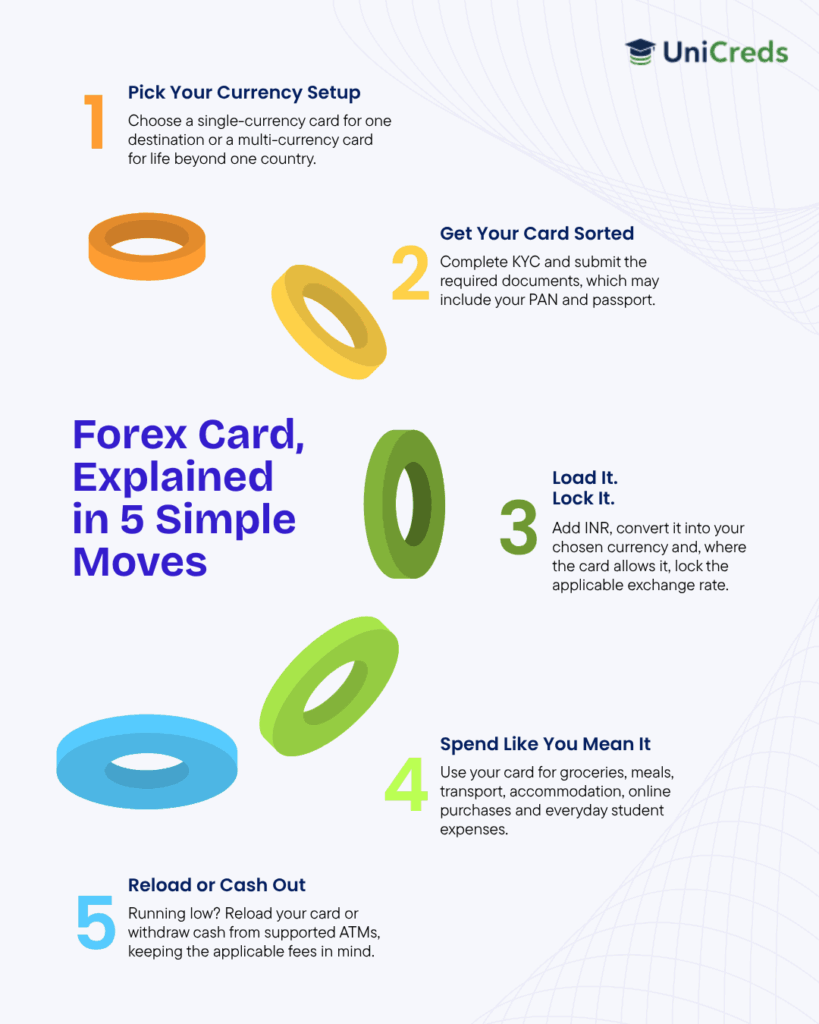
Step 1: Compare your options
Start with the things that will affect your actual spending abroad:
- Currencies supported: Make sure your study destination is covered.
- Exchange rates: Compare the provider’s rate before loading money.
- Forex card charges: Check issuance, reload, replacement and inactivity fees.
- ATM charges: Find out what you pay for overseas cash withdrawals.
- Reload options: Check how you can add money and how long it takes.
- App features: Look for balance checks, transaction history and card controls.
- Customer support: Check how you can get help if something goes wrong.
- Student benefits: Some cards offer student-focused features or travel benefits.
Do not pick a card because its joining fee looks cheap. The fees you pay repeatedly can matter more during a full semester.
Step 2: Check your eligibility
Eligibility depends on the card provider and your circumstances. Check the provider’s current requirements before starting your application. For students travelling abroad for education, the provider may ask for details about your destination, travel purpose and planned travel dates.
Step 3: Keep your documents ready
The documents you need can vary from one forex card provider to another. You may be asked for your PAN card, passport, visa, air ticket or travel details, along with address or other KYC documents.
Some providers may ask for extra paperwork too. HDFC, for example, lists a passport, visa, ticket and PAN among its forex card requirements. Check your provider’s latest document list before applying, especially if your departure date is close.
Step 4: Complete KYC
Submit the required documents and complete the KYC process. The card provider may ask for additional information before approving the application. RBI rules require forex prepaid cards to be issued by authorised dealers, subject to applicable KYC requirements.
Step 5: Load the card
After approval, you can load funds onto your forex card for your expenses abroad. Do not rush this step. Check the exchange rate, applicable charges and the amount you plan to spend. With a multi-currency card, confirm that you have loaded the correct currency before travelling.
Step 6: Activate it before travelling
Do not leave activation until you reach the airport. Activate the card, set your PIN and check that it works before leaving India. It is also worth making one small test transaction before your departure.
Step 7: Save your emergency details
Keep the provider’s customer support number somewhere you can access without the card.
Save details for card blocking, replacement and emergency assistance on your phone. If your wallet disappears abroad, you do not want to search for these details while stressed.
Do one final card check before heading to the airport. Make sure the balance is enough, the card has not expired and your destination currency is supported. Keep the ATM rules and emergency support number handy too. It is much easier to fix a problem before your flight than after landing.
Tips for Using a Forex Card Abroad
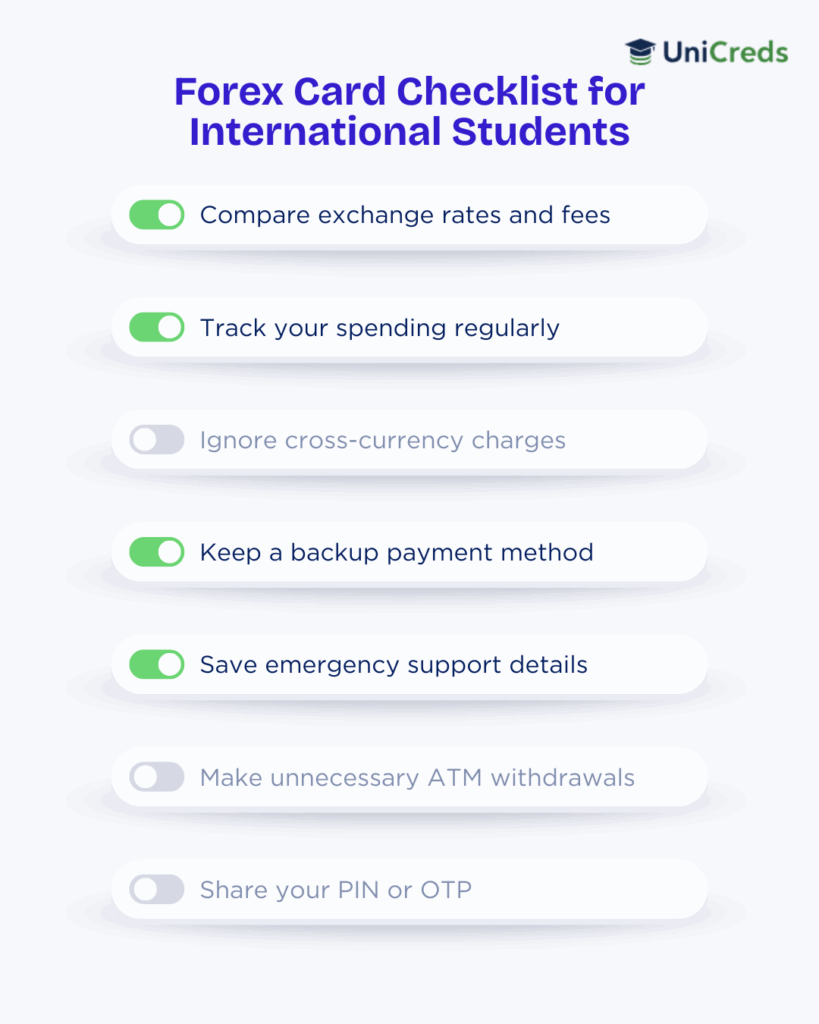
A forex card becomes most useful when you know how to use it before something goes wrong. A few checks at home can save you from awkward payment failures abroad.
Before leaving India:
- Activate the card early. Do this before your flight, not after landing. Make sure the card works and note its expiry date.
- Check your PIN. Keep it somewhere secure and avoid writing it on the card.
- Save customer support details. Store the provider’s helpline number separately from your card details.
- Download the app. If your card has an app, log in before leaving India. Check your balance and learn where to find transaction details.
- Check your currencies. Make sure your destination currency is supported and loaded correctly.
- Understand the charges. Check ATM fees, reload costs, cross-currency charges and any spending limits.
- Carry a backup payment method. Keep a debit or credit card separately from your forex card. It can help if your primary card gets blocked or declined.
Once Abroad:
- Check transactions regularly. Go back to your app now and then so you can flag anything you do not recognise quickly.
- Keep some emergency cash. A small amount can come in handy when a shop, café or local transport service does not accept cards.
- Choose the payment currency carefully. If you see INR and the local currency on screen, check the conversion terms before confirming. DCC can make the transaction costlier.
- Avoid unnecessary ATM withdrawals. Plan your cash needs instead of making several small withdrawals that may each attract a fee.
- Reload before your balance becomes critical. Do not wait until your card gets declined at the checkout. Check how long your provider takes to process a reload.
- Protect your PIN and OTP. Never share either with anyone, even if someone claims to represent your card provider.
Wrapping Up!
Money abroad has a funny habit of shrinking in small pieces. A coffee here, a grocery run there, and suddenly your monthly budget needs a serious rethink.
A forex card can give you a clearer way to handle those everyday expenses, but the card you pick matters. Look beyond the headline benefits and check the exchange rate, supported currencies, ATM fees, reload costs and spending limits.
Most importantly, choose around your actual student life. Your university city, travel plans and monthly budget should shape the decision. Get that part right, and managing money abroad becomes one less thing competing for your attention when university life gets busy.
FAQs
- What is the difference between a forex card and a debit card?
A forex card is prepaid, while a debit card takes money directly from your bank account. You load a forex card with foreign currency before spending abroad. With a debit card, each payment comes from your linked bank account and usually involves currency conversion at the time of purchase.
- Is a forex card safe for international students?
Yes, a forex card can be a safe option for international students when used carefully. You can avoid carrying large amounts of cash and keep your overseas spending separate from your main bank account. Many cards also offer features such as card blocking, transaction alerts and replacement support.
- Can I withdraw cash using a forex card?
Yes, you can withdraw cash using a forex card at supported international ATMs. Your provider may set withdrawal limits and charge an ATM withdrawal fee.
- Do I need a PAN card for a forex card?
You generally need a PAN card when applying for a forex card in India, but requirements vary by provider.
- Can I use a forex card to pay university fees?
You may be able to use a forex card for university payments if the institution accepts that card and transaction type. However, large tuition payments can have card limits, merchant restrictions or additional charges.
- What should you do if you lose your forex card abroad?
Block your forex card immediately if you lose it abroad. Use your provider’s app, website or emergency helpline if available. Ask about replacement options and emergency cash support.









0 Comments